

Why Ports and Shipbuilding Are Essential to American Competitiveness, Security, and Resilience
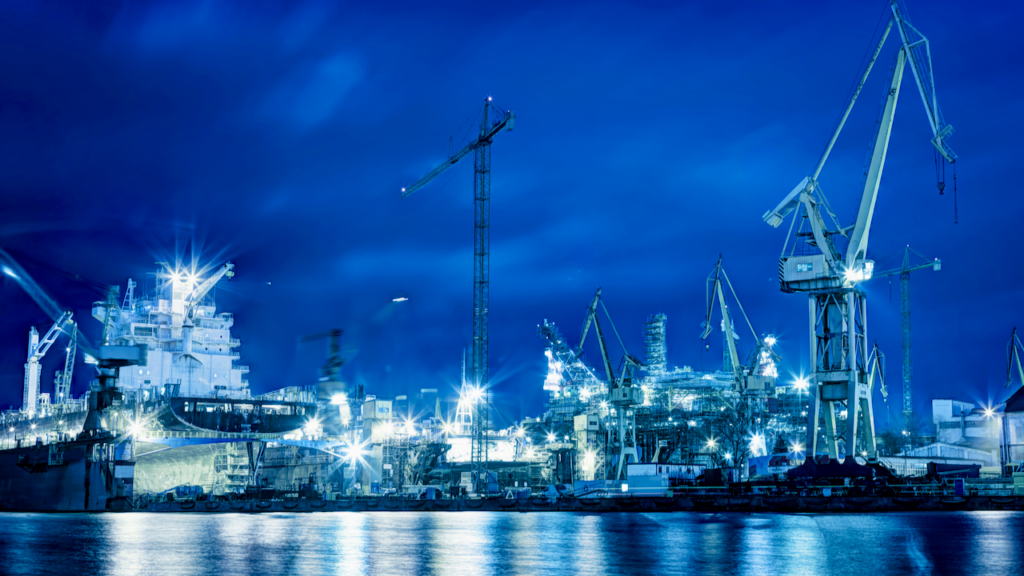
Basis of Remarks for Serving America’s Working Waterfronts panel at Capitol Hill Ocean Week 2026
Walk along many waterfronts today and you will see restaurants, apartments, parks, and recreational spaces. These developments often improve quality of life and reconnect communities to the water. Yet as cities transform their shorelines, an important question arises: What happens when working waterfronts disappear?
This question is not merely local. It is increasingly strategic.
In an era defined by artificial intelligence, supply chain competition, digital infrastructure, and geopolitical rivalry, working waterfronts are becoming more important—not less. Ports, shipyards, maritime logistics hubs, and industrial waterfronts are critical components of the systems that underpin prosperity, security, and technological leadership.
The future will not be won solely in laboratories, data centers, or boardrooms. It will also be shaped on the docks, in the shipyards, and along the waterfronts that connect nations to the global economy.
The Physical Infrastructure of Prosperity
The maritime economy remains the backbone of global commerce.
More than 80 percent of world trade by volume moves by sea. Energy, agricultural products, manufactured goods, critical minerals, and consumer products all depend on maritime transportation. The overwhelming majority of cargo entering the United States arrives through seaports.
When ports function efficiently, businesses benefit from lower logistic costs, consumers enjoy lower prices, and supply chains operate smoothly. When they fail—as the world witnessed during the pandemic—the consequences ripple through the entire economy.
For decades, many viewed ports as mature infrastructure serving traditional industries. Today, they should be viewed differently. Ports are not relics of the industrial economy. They are foundational infrastructure for the digital economy.
Every AI data center begins with a supply chain. Every supply chain begins with a port.
Why AI Will Increase the Importance of Oceans
Artificial intelligence is often portrayed as a purely digital phenomenon. The reality is far more physical.
The expansion of AI requires semiconductors, servers, cooling systems, power generation, and vast quantities of critical minerals. These materials must be mined, processed, manufactured, and transported. Most move through maritime networks.
AI is also transforming the oceans themselves.
Ports around the world are deploying automation, predictive analytics, digital twins, autonomous equipment, and AI-enabled logistics systems. Smart ports in Brazil, Peru, Jamaica, Singapore, and elsewhere are demonstrating how technology can improve efficiency, reduce congestion, and enhance competitiveness.
The port of the future will not simply move cargo. It will process information.
As AI advances, the world’s ports are becoming data platforms as much as transportation hubs.
The Systems Race at Sea
The competition between the United States and China is increasingly a competition between systems.
China does not view shipbuilding, ports, logistics, shipping, and digital infrastructure as separate industries. It views them as components of an integrated national strategy.
Over the past two decades, China has built the world’s largest shipbuilding industry, expanded its commercial shipping fleet, invested in ports around the globe, and developed digital logistics platforms that increasingly influence the flow of international commerce.
The United States retains enormous strengths in innovation, technology, entrepreneurship, and alliances. Yet it has fallen behind in several maritime sectors that once underpinned its economic and strategic power.
America’s challenge is not simply to build more ships or modernize individual ports. It is to think more systematicallyabout maritime competitiveness.
Ports, shipbuilding, shipping, logistics, digital infrastructure, and workforce development are interconnected. Success in one area increasingly depends on success in all of them.
Ports Are Becoming Strategic Assets
The strategic value of ports extends far beyond the movement of goods.
Ports increasingly sit at the intersection of physical and digital networks. They are connected to rail systems, highways, energy infrastructure, undersea communications cables, cloud services, and logistics platforms. They support commercial activity, military mobility, emergency response, and international trade.
The growth of undersea communications infrastructure further elevates their importance.
The world’s digital economy depends on submarine cables that carry nearly all international internet traffic. The landing points for many of these systems are located near ports and coastal infrastructure.
The movement of goods and the movement of data increasingly rely on the same geography.
This convergence means that working waterfronts are no longer merely transportation assets. They are strategic nodes in the global flow of commerce, information, and influence.
Shipbuilding Is More Than Manufacturing
The decline of American shipbuilding is often viewed as an industrial policy issue. It is much more than that.
Shipbuilding represents productive capacity—the ability of a nation to design, construct, repair, and sustain the vessels that support commerce and security.
Industrial capacity matters.
A nation that cannot build ships becomes increasingly dependent on others for maritime transportation, logistics, and strategic mobility. Conversely, a strong shipbuilding sector supports manufacturing, engineering, workforce development, innovation, and national resilience.
The future of shipbuilding will increasingly integrate advanced manufacturing, automation, digital twins, robotics, and artificial intelligence. The shipyards of tomorrow will look very different from those of the past.
Yet they will remain just as important.
The Workforce Opportunity
Perhaps the most compelling reason to preserve working waterfronts is the opportunity they create for people.
The maritime economy supports careers that are essential to America’s future.
These include welders, electricians, mechanics, mariners, engineers, logistics specialists, cybersecurity professionals, robotics technicians, and AI-enabled operations managers.
The future waterfront workforce will be more technologically sophisticated than ever before. It will require new skills and new training pathways. But it will continue to provide opportunities for workers across a wide range of educational backgrounds.
In an era when policymakers rightly focus on workforce development and economic mobility, working waterfronts should be viewed as talent ecosystems as much as industrial assets.
A False Choice
Too often, communities are presented with a choice between development and preservation, between economic growth and quality of life.
In reality, the challenge is achieving balance.
Communities need housing, public spaces, and access to the water. They also need places that produce, build, move, and innovate.
Once a shipyard becomes condominiums, it rarely becomes a shipyard again. Once industrial waterfront capacity is lost, it is extraordinarily difficult to replace.
Deepwater access is one of the few strategic assets that cannot be relocated.
The goal should not be to freeze waterfronts in time. It should be to ensure that future generations inherit waterfronts capable of supporting both vibrant communities and a competitive economy.
The Strategic Imperative
Working waterfronts helped build America’s prosperity. They helped secure America’s rise as a global power. Today they remain essential to America’s competitiveness in a world increasingly shaped by technology, supply chains, and strategic competition.
The Age of AI will not diminish the importance of ports, shipyards, and maritime infrastructure.
It will increase it.
The future belongs not only to those who develop the best algorithms, but also to those who build the systems that allow economies to operate, innovate, and compete. Ports, shipbuilding, logistics networks, and maritime infrastructure are among the most important of those systems.
Working waterfronts are not relics of the industrial age.
They are critical infrastructure for the systems age.
Author

Mark Kennedy
Director - Development Research Institute