

Reflections as Our Nation Approaches Its 250th Birthday
When I was ten years old, my family took our first vacation outside Minnesota — to Virginia, to visit my Uncle Earl Kennedy, a Pearl Harbor veteran and devoted student of American history. I had no idea that one trip would shape how I thought about our country for the rest of my life.
Uncle Earl took us to Jamestown, where America’s first permanent English settlement struggled to survive. To Colonial Williamsburg, where the Virginia House of Burgesses helped launch the movement that ultimately led to the Declaration of Independence. To Yorktown, where Cornwallis surrendered to Washington, securing American independence. To a ten-year-old boy from rural Minnesota, these weren’t places in a history book anymore. They were real.
But the stop that left the deepest impression wasn’t Jamestown or Yorktown.
It was the National Archives.
There, behind protective glass, rested two documents that have shaped the course of history: the Declaration of Independence and the Constitution of the United States. At ten, I couldn’t fully grasp their significance. But I sensed that this was hallowed ground. These weren’t old pieces of parchment. They were America’s birth certificate and instruction manual — proclaiming the revolutionary idea that our rights come not from kings or governments, but from our Creator, and that governments derive “their just powers from the consent of the governed.”
That trip didn’t just teach me American history. It helped me understand what America means.
A few years later, during the Bicentennial in 1976, I had the privilege of portraying Robert R. Livingston of New York in our community theater’s production of 1776. Night after night, I stood on stage with neighbors portraying the remarkable men who argued passionately, compromised, and ultimately pledged “our Lives, our Fortunes and our sacred Honor.”

My favorite moment has always been John Adams standing alone, asking whether anyone else could see the nation that existed only in his imagination. While others saw uncertainty and risk, Adams saw something entirely different — a free people, fireworks, parades, and generations of Americans living in liberty.
That question has stayed with me ever since: Can we still see what they saw?
1776 became our family’s Fourth of July tradition. Every Independence Day, we watched the movie together, and in those early years I sang along enthusiastically with every song. Eventually, one of our daughters said what everyone else was probably thinking: “Dad…please stop singing.”
So I did. At least for a while.
As the years passed, something unexpected happened. One by one, everyone else began singing too. Watching 1776 became more than a movie night. It became one way our family remembered where our freedoms came from.
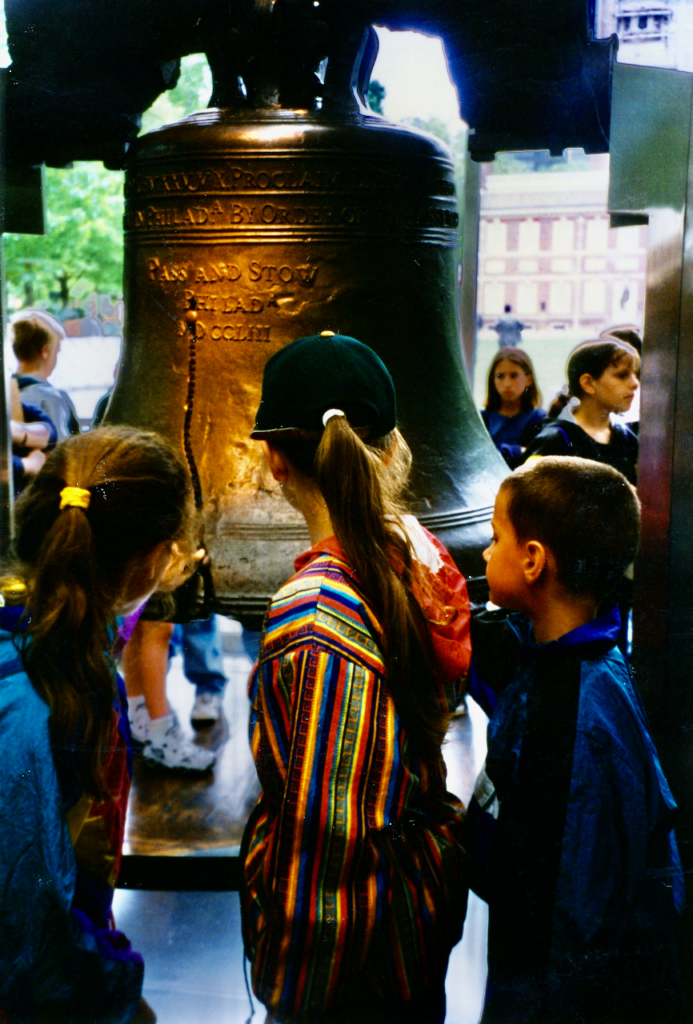
As our four children reached roughly the age I had been on that trip with Uncle Earl, Debbie and I tried to give them the same gift. We took them to Jamestown and Williamsburg, to Yorktown and Washington, to Monticello and Mount Vernon, to Independence Hall, the Liberty Bell, and the home of John Adams. We wanted them to do more than read about history. We wanted them to walk where it happened, stand where it happened — and sometimes, quite literally, reach out and touch it. My daughter observed, “Dad, we never went on vacations. We went on Kennedy family field trips.”
Just a few weeks ago, Debbie and I saw 1776 performed at Ford’s Theatre — not once, but twice. Watching it, I found myself thinking less about the musical than about the remarkable chain of Americans who have carried this story from one generation to the next. Uncle Earl did it for me. Debbie and I tried to do it for our children. Now, as our grandchildren reach that same age, I find myself looking forward to making those journeys again.
Our nation is approaching its 250th birthday. The American experiment has endured not because every generation has agreed on every issue. Far from it. Nor have we always lived up to the ideals proclaimed in 1776. Yet, at our best, Americans have returned to those ideals again and again, striving to make them more fully real for each succeeding generation. That is part of what makes our story so remarkable. It has endured because generation after generation embraced the principles first proclaimed in 1776: that all are created equal, that liberty is worth defending, that free people can govern themselves, and that each generation bears responsibility for passing those blessings to the next.
Freedom is not self-sustaining. Neither is civic memory. Like a song, both survive only if someone teaches them, someone learns them, and someone passes them on.
This Fourth of July, I hope families gather together. I hope grandparents tell stories and children ask questions. I hope parents explain why those old documents behind glass in the National Archives still matter. I hope you’ll visit the places where America’s story began. And if your family happens to watch 1776, I hope you’ll sing along.
Because 250 years ago, imperfect men imagined an extraordinary nation. Every generation since has been asked whether it can still see what they saw — and whether it will do its part to keep that vision alive.
This Independence Day, I hope we’ll all sing along.
More importantly, I hope we’ll help the next generation learn America’s song.
Author

Mark Kennedy
Director