

How AI is Reshaping Industry
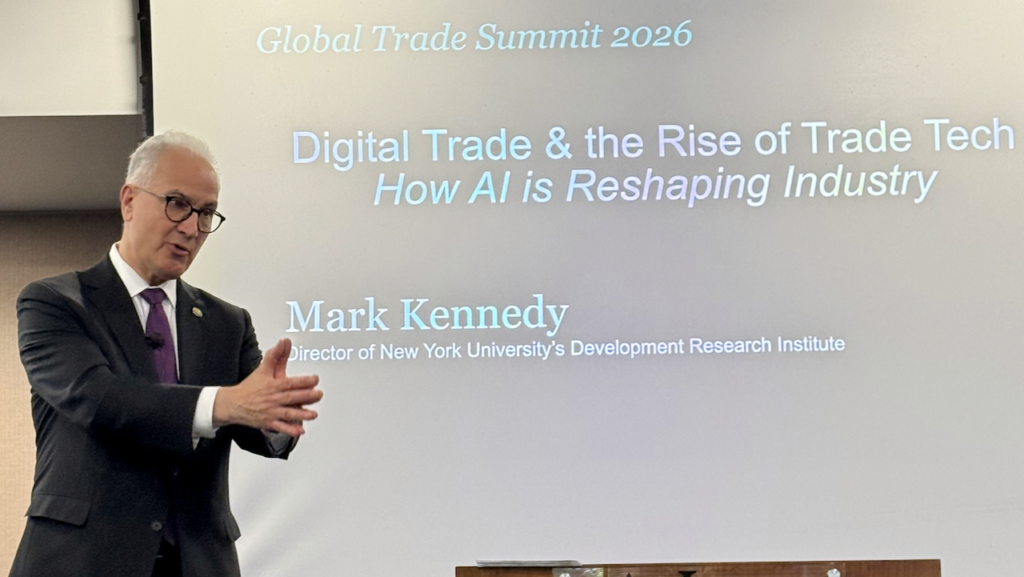
Photo: Speaking recently in Silicon Valley. I’ve adapted those remarks into this piece.
Global trade is undergoing a profound transformation. What was once centered on the movement of physical goods is increasingly defined by the movement of information, software, data, and intelligence around those goods. At the same time, geopolitical fragmentation is reshaping markets, standards, and supply chains. Together, these forces are creating a new competitive environment—one in which success will depend less on managing individual transactions and more on building systems that adapt, learn, and scale.
I first began thinking about this distinction more than four decades ago. As a college intern at Eastman Kodak in the summer of 1982, a colleague asked me a deceptively simple question: Are you a project thinker or a process thinker?
At the time, I did not have an answer. But I have since come to believe that distinction helps explain not only Kodak’s trajectory, but increasingly the challenge facing firms and nations alike.
Project thinkers optimize individual outcomes. Process thinkers build systems that generate outcomes over time.
Kodak, founded by George Eastman, was once a master of systems thinking. It did not simply sell cameras. It built an ecosystem of film, processing, and distribution in which each element reinforced the others. Every new user strengthened the overall system. That is what scale looked like in an earlier industrial era.
Over time, however, Kodak became more focused on optimizing products within an inherited model rather than evolving the model itself. The result was not immediate collapse, but something more dangerous: gradual irrelevance.
Systems Thinking in Modern Industry
Many of the most successful firms of the modern era have instead embraced process thinking.
Intel built a manufacturing and innovation system that advanced generation after generation. NVIDIA has built not just chips, but an integrated ecosystem of hardware, software, and developers. Amazon transformed retail through logistics, cloud infrastructure, and data systems that reinforced one another. SpaceX built an interconnected model of launch, reusability, satellites, and global connectivity through Starlink.
In each case, the value was not in a single product alone. It was in the system surrounding it. That same distinction now applies to trade policy and global competition.
From Trade Deals to Trade Systems
For decades, the United States helped shape the rules of the global trading system. It championed institutions, standards, and agreements that lowered friction, increased interoperability, and allowed scale to emerge.
The Trans-Pacific Partnership was a particularly important example. It was not simply about tariffs. It was about writing rules for the next era of digital commerce, data flows, and services trade.
When the United States stepped away, it did not merely forgo a deal. It stepped back from shaping part of the system.
Some of that logic survived in USMCA, particularly in its digital provisions. But in recent years, trade policy has often shifted toward bilateral leverage and tactical outcomes rather than long-term system design.
Meanwhile, others have continued building.
China has deepened regional integration through the Regional Comprehensive Economic Partnership, creating a more seamless commercial environment across much of Asia. It has also applied to join the Comprehensive and Progressive Agreement for Trans-Pacific Partnership. Whether or not that accession occurs, the strategic logic is clear: systems matter.
Trade Has Become Digital
Trade itself has also changed. It is no longer only about containers, customs forms, and ports. It increasingly depends on:
- Design files transmitted across borders
- Software updates tied to physical equipment
- Real-time supply chain visibility
- Data coordination across suppliers and customers
- Cloud-based documentation and workflows
- AI layered onto operational decisions
In this environment, if you cannot see the information, you often cannot truly see the trade.
This is one reason trade functions inside companies feel more complex than they did a decade ago. Rules are shifting. Standards are diverging. Export controls are evolving. Firms are no longer operating inside a stable system. They are operating inside one that moves while they are in motion.
Why This Matters for Advanced Manufacturing
In advanced manufacturing, the value of information compounds across production steps. A tool used in one stage of semiconductor fabrication generates data that can improve performance downstream and inform optimization upstream. The advantage comes not only from the tool itself, but from how effectively the surrounding system captures and uses intelligence.
The same principle applies to global operations.
A single shipment may require the integration of classification, licensing, end-use review, customer screening, contractual terms, and real-time regulatory changes across multiple jurisdictions. Too often, that information remains dispersed across disconnected systems, emails, spreadsheets, and functional silos.
That is no longer merely a compliance challenge. It is a systems orchestration challenge.
The Corporate Imperative
National policy matters. Better alignment among allies would reduce friction and strengthen competitiveness. But firms cannot build strategy around the assumption that geopolitics will soon become simpler.
Fragmentation may persist. Rules may diverge further. Trusted and untrusted technology ecosystems may continue to separate.
That reality creates an imperative for companies: build internal systems that neutralize externally generated complexity.
Those systems must do three things simultaneously:
- Maximize efficiency by reducing repetitive friction
- Maximize visibility across jurisdictions, risks, and dependencies
- Maximize reach by enabling lawful participation across as many markets as possible
Reach is not just a commercial concept. It can preserve market presence, sustain learning, and delay competitive substitution.
AI as a Decision Layer
Many firms are already adopting new tools: upgraded enterprise software, specialized compliance platforms, large language models, and increasingly AI agents.
These technologies matter. But tools alone are insufficient. The deeper challenge is often that systems do not see one another. If AI cannot access workflows, signals, and relevant data, it cannot meaningfully improve decisions.
The next frontier is AI not merely as an assistant or search tool, but as a decision layer—connecting information across systems, identifying patterns, anticipating risks, and accelerating judgment.
That transformation will require strong leadership from IT, but it cannot be achieved by IT alone. Trade, legal, engineering, operations, finance, and executive leadership must act together. This is not a software purchase. It is a capability build.
The Process World Ahead
We are entering an AI-driven era. As quantum computing matures, AI capabilities may accelerate further. If breakthroughs such as commercially viable fusion energy emerge over time, constraints on compute and power could change dramatically.
Whatever the timeline, the direction is clear: we are moving deeper into a process world. In such a world:
- Systems matter more than isolated transactions
- Speed of adaptation matters more than static advantage
- Integration matters more than standalone tools
The countries that succeed will be those that build systems. The companies that succeed will be those that integrate systems. The individuals who succeed will be those who can operate across systems at speed.
Kodak did not fail because it lacked technology. It failed because it stopped evolving the system around it.
That is the enduring lesson for trade, industry, and leadership today. In a system-driven world, the edge goes to those who see first—and act fastest.
Development Impact: As global trade becomes more digital, data-driven, and rules-intensive, developing economies risk being left behind if they lack trusted digital infrastructure, interoperable standards, and the institutional capacity to navigate complex trade systems. Expanding access to modern trade technology can help emerging markets participate more fully in global commerce, attract investment, and accelerate productivity growth.
Author

Mark Kennedy
Director - Development Research Institute