

How Gulf Region Sovereign Wealth Funds Are Building Jensen Huang's AI Layer Cake
By Winston Ma, DRI-WISC Affiliate, Executive Director of NYU’s Global Public Investment Funds Forum (GPIFF), and Adjunct Professor, NYU School of Law
This case study examines how Gulf region sovereign wealth funds—particularly in Abu Dhabi—are building AI capabilities across the full technology stack. While not universally replicable, the model offers insight into how capital, energy, and state coordination can accelerate AI deployment at scale. It also raises broader questions about access, alignment, and the emerging global distribution of AI infrastructure.
______________________________________________________________________________
Sovereign AI Tech Stack: The Five-Layer Cake
In February 2024, Jensen Huang stood on a stage in Dubai at the World Governments Summit and made a declaration that reframed the global AI conversation. “Every country needs to own the production of their own intelligence,” the Nvidia founder told thousands of government delegates from 150 nations. He contended that AI was not merely a technology to be purchased or licensed — it was a sovereign asset, as strategic as land, currency, or military capacity. “It codifies your culture, your society’s intelligence, your common sense, your history,” he said. “You own your own data.”
Seated beside him was the UAE’s Minister of AI, Omar Al Olama. “We completely subscribe to that vision,” Al Olama replied. “That’s why the UAE is moving aggressively on creating large language models and mobilizing compute.” The exchange, largely overlooked outside the Gulf region at the time, now reads as the opening of the most consequential sovereign investment story of this decade.
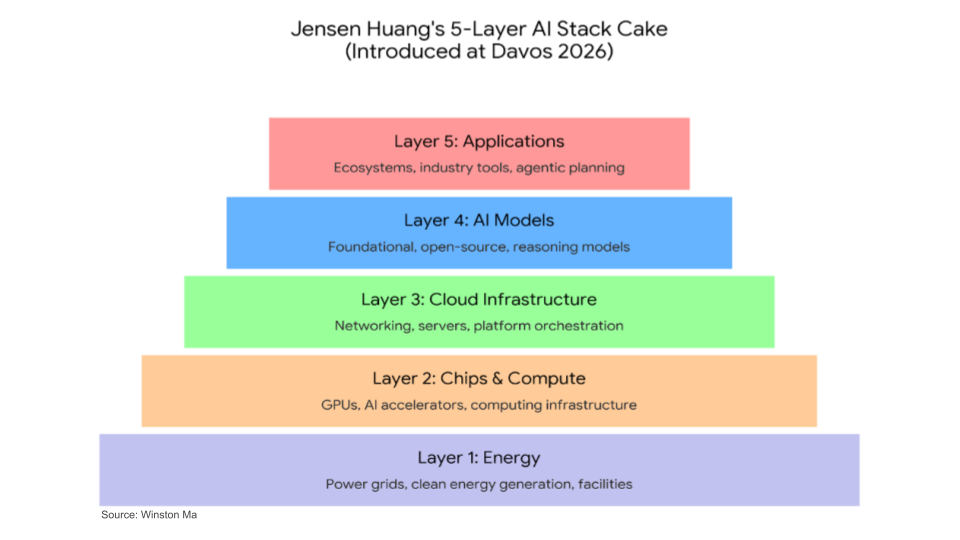
Huang would return to the global stage at Davos in January 2026 with a structural complement to his sovereign AI thesis: the five-layer cake. He described the AI economy as a stack with energy at its base, then chips and computing hardware, cloud infrastructure, foundation models, and finally, applications at the top. (See the Figure above.)
The two frameworks—sovereign AI and the five-layer stack—are, in Huang’s vision, two sides of the same coin. Sovereign AI is a strategic imperative. The stack is the construction blueprint. Together they answer the question every government has been quietly asking since ChatGPT: how do you actually build this from the ground up, using your own resources?
Abu Dhabi: Sovereign AI, Layer by Layer
No ecosystem has answered Huang’s call more completely than Abu Dhabi. Its response to Huang’s sovereign AI concept is a coordinated architecture of multiple sovereign wealth funds (SWF). Collectively, they are making bold investments into leading-edge technologies that may have long-term impact on UAE’s AI economy.
- At the energy layer, the national oil company ADNOC provides the hydrocarbon base while Masdar, the SWF ADQ’s clean- energy subsidiary, advances the power transition that AI’s compute demands will require.
- At the compute layer, MGX (affiliated with Mubadala) anchored the Stargate project and co-led the $40 billion acquisition of Aligned Data Centers with BlackRock—owning the AI factories Huang described as places “where data comes in and intelligence comes out.”
- Core42 and G42 Cloud, invested by the SWF Mubadala, provide GPU-scale domestic cloud infrastructure at Layer 3, flanked by a sovereign Azure cloud partnership with Microsoft.
- At the model layer, its Technology Innovation Institute (TII) launched Falcon-H1 Arabic in January 2026, considered the most capable Arabic language model developed to date.
- At the application layer, Inception, G42’s applied AI arm, builds commercial products on top—(In)Health, (In)Climate, (In)Procurement—deploying specialized, high-impact AI solutions across fintech, healthcare, and government services across the UAE and MENA region.
Further, establishing the Mohamed bin Zayed University of Artificial Intelligence (MBZUAI) (the world’s first graduate-level, research-based AI university) added a “Layer Zero” to Abu Dhabi’s AI cake: human capital and foundational research. MBZUAI cultivates local AI talent and develops sovereign AI research simultaneously. For example, MBZUAI developed K2 Think, an open-source reasoning system designed to make AI decisions interpretable and trustworthy for key sectors such as energy management (layer 4 and layer5).
The open question is whether this model aligns with U.S.-led technology ecosystems or if it contributes to a more fragmented, multipolar AI landscape.
The Gulf Region Consensus
Abu Dhabi’s approach has catalyzed a broader Gulf region response by their respective countries’ SWFs.
- Saudi Arabia’s Public Investment Fund (PIF) launched HUMAIN, planning 600,000 Nvidia GPUs and a sovereign Arabic LLM called ALLAM, deploying AI as the instrument of Vision 2030 economic transformation.
- Kuwait Investment Authority (KIA) joined the BlackRock-Microsoft AI Infrastructure Partnership, a consortium targeting up to $100 billion in global AI infrastructure investment.
- Qatar Investment Authority (QIA), through its Qai subsidiary, closed a $20 billion AI infrastructure joint venture with Brookfield in late 2025, anchoring earlier positions in xAI and Databricks.
Across the Gulf region, the logic is consistent: SWFs not as passive allocators but as sovereign AI builders, owning the full stack from energy to application. As Gulf region SWFs face pressure to review sovereign investments amid regional tensions, the UAE said it was sticking with its investment plans.
“The UAE has adopted forward-looking economic strategies that enhance its capacity to absorb any geopolitical and economic pressures,” the UAE’s Ministry of Foreign Affairs said in a statement. “In this regard, there is no change to investment plans or long-term economic priorities.” The UAE is poised to emerge as a leading AI center of the world.
Conclusion: Sovereign AI is Critical for Future Economy
SWFs can act as both capital providers and technology integrators—deploying patient capital at scale while embedding AI across national economic holdings to generate compounding strategic advantages. SWFs such as Mubadala uniquely combine the capital scale, time horizon, and industrial portfolio breadth to invest in AI not only as a financial bet, but also as an ecosystem catalyst for national economies. The five-layer stack (six, if you count layer zero) is the map and Sovereign AI is the destination.
___________________________________________________________________________
Development Impact: While the Gulf region model demonstrates what is possible with coordinated sovereign capital, most countries will not build full-stack AI ecosystems. For many emerging markets, access—through trusted cloud infrastructure, partnerships, and financing mechanisms—will be more realistic than ownership. The risk is that AI capacity becomes concentrated in a small number of capital-rich states, widening the global “infrastructure of intelligence” divide unless access models are deliberately designed.
Author
Winston Ma
DRI-WISC Affiliate