

A Field Report From European Policy Circles
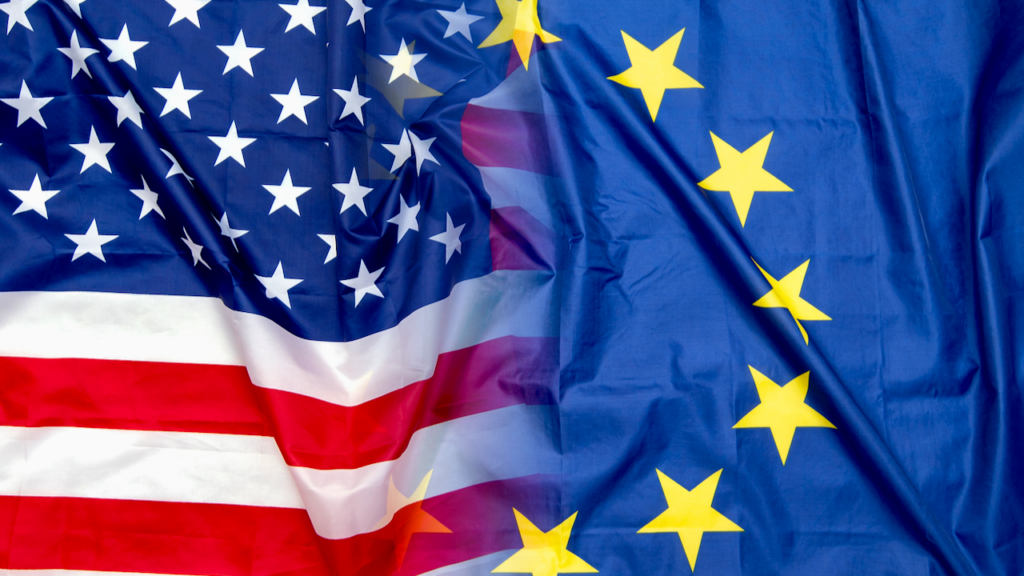
The views reported here are those of European interlocutors (senior government and business leaders, academics, and representatives of think tanks and international organizations) not assessments of the merits of any specific American policy. European perceptions of American reliability will shape technology and security decisions that matter for democratic competitiveness. WISC shares these perspectives so policymakers and business leaders on both sides of the Atlantic can engage with them constructively.
Five days of meetings in June 2026 in London, Brussels, and Paris revealed something that official communiqués will not articulate. European interlocutors spoke about the United States with a mixture of uncertainty, frustration, and strategic restlessness.
What was notably absent from these conversations was telling. No one complained about spending more on defense. That argument—long a source of transatlantic friction—has been quietly set aside. Europe is investing in its own capabilities, and most interlocutors accept that this was overdue. The concerns on the table were more fundamental.
A Europe Searching for Agency
The most striking feature of these conversations was not anti-Americanism. It was uncertainty. European policymakers are asking questions that, until recently, many had not seriously entertained.
Can Europe continue to rely on the United States in the same way it has since World War II? How should Europe respond to a China that increasingly threatens its industrial base? How can Europe reduce vulnerabilities without sacrificing prosperity? What responsibilities must Europe now assume for its own defense and competitiveness?
Senior officials openly reassessed assumptions about the durability of the postwar democratic order. That reassessment is a strategic signal worth taking seriously, whatever its underlying causes.
The French were notably unsurprised by the current moment. They had been arguing for greater European strategic autonomy for decades, a posture finding a wider audience in Brussels and beyond.
The Business Perspective
Anxieties were not confined to governments. Business leaders expressed many of the same concerns, though often in more immediate terms. They recognize the need for greater resilience in critical supply chains. They also worry about excessive dependence on any single provider or market. They increasingly view economics, technology, and security as interconnected rather than separate spheres.
Yet they also are concerned that the impulse toward sovereignty could inadvertently undermine competitiveness. Businesses thrive on scale. Digital technologies in particular consolidate through network effects, accumulated expertise, and capital intensity. Fragmentation carries costs. The question business leaders were asking was how to pursue resilience without sacrificing the interoperability and scale that make democratic technology worth adopting in the first place.
The False Equivalence
Perhaps the most strategically significant observation from conversations was the degree to which some senior European policy officials are now framing the United States and China as equivalent pressures on European autonomy—two large powers, each with the ability to shape European choices in ways that may not align with European interests.
This framing appeared in many conversations, and it deserves direct engagement. An ally with whom one has serious policy disagreements is different from a strategic competitor whose model of governance, technology, and international order is incompatible with democratic values. Losing sight of that distinction carries real strategic costs for Europe and for the broader democratic ecosystem.
Europe is not moving toward China. If anything, European threat perception of China has sharpened considerably. But the drift toward treating the transatlantic relationship as simply one of several competing power relationships rather than as a foundational partnership of shared democratic values is a signal worth monitoring and addressing where possible.
Perceptions Shaping the Strategic Environment
European interlocutors repeatedly raised specific issues as proxies for the broader question of American reliability.
Regarding Russia, European interlocutors are attentive to the direction of American policy and its implications for European security architecture. The degree of uncertainty they expressed was notable and is informing and reorienting European technology and investment decisions.
On broader questions of alliance management, the concern was in how Washington conceptualizes partner relationships and about transactional rather than durable alliance frameworks. Whether or not that perception is accurate, it is shaping European behavior in ways that have direct consequences for democratic ecosystem coherence.
These perceptions form the backdrop against which Europe’s technology choices will be made. Trust does not operate in isolated domains. A transatlantic relationship perceived as uncertain in the security and political domains will face elevated scrutiny in the technology domain as well.
Not a Pivot—A Recalibration
None of this should be read as Europe pivoting toward China or withdrawing from the democratic technology ecosystem. The conversations in London, Brussels, and Paris were not those of nations preparing to change sides, but of allies engaged in a consequential strategic recalibration.
China is increasingly seen as a genuine threat. European thinking on China has shifted more in the past 18 months than in the previous decade, driven by the visceral evidence of industrial competition: Chinese electric vehicles entering European markets at scale, concerns about autonomous systems carrying Chinese-controlled technology onto European roads, and explicit Chinese messaging to European governments about the costs of confrontation.
Europe’s instinct is not to choose sides, but to create enough strategic capacity to retain meaningful agency over its own choices. That instinct is not inherently hostile to democratic ecosystem goals. A more capable, self-confident Europe that invests seriously in its own defense and technology capacity is ultimately a stronger pillar of the democratic digital order.
Realizing that potential requires movement on both sides. As Europe invests more in its own capabilities, the United States must demonstrate the kind of consistent partnership that makes alliance membership a strategic asset. And Europe must resist the drift toward treating trusted democratic partners and authoritarian strategic competitors as interchangeable pressures.
What This Means for the Democratic Digital Ecosystem
The future digital order will be shaped by two competing ecosystems—one democratic and open, the other authoritarian and closed. The democratic ecosystem cannot prevail if it limits its vision to the roughly 15 percent of the global population living within the United States and in its allied countries. It must expand to bring the Global Middle onboard. However, the conversations in Europe suggest a more immediate risk—that the core of that democratic ecosystem is itself fracturing under the weight of uncertainty.
European nations are foundational members of the democratic order, with sophisticated institutions and shared commitments to the values that underpin open digital systems. If Europe separates into its own digital sphere, the democratic ecosystem will have a coordination problem that no amount of investment in the Indo-Pacific or the Global South can resolve.
Sustaining the confidence of democratic allies requires consistent engagement over time—not declarations, not frameworks, not bilateral digital trade agreements, though those matter too. It requires the kind of steady, reliable partnership that assures that the question of shared interest is settled.
Partnership based on trust is the precondition for everything else.
Author

Mark Kennedy
Director - Development Research Institute