

How democracies can align critical minerals, infrastructure investment, and trusted interdependence to compete and prosper.
The G7’s Comparative Advantage: Organizing Democratic Strength
By Mark Kennedy, NYU DRI Director
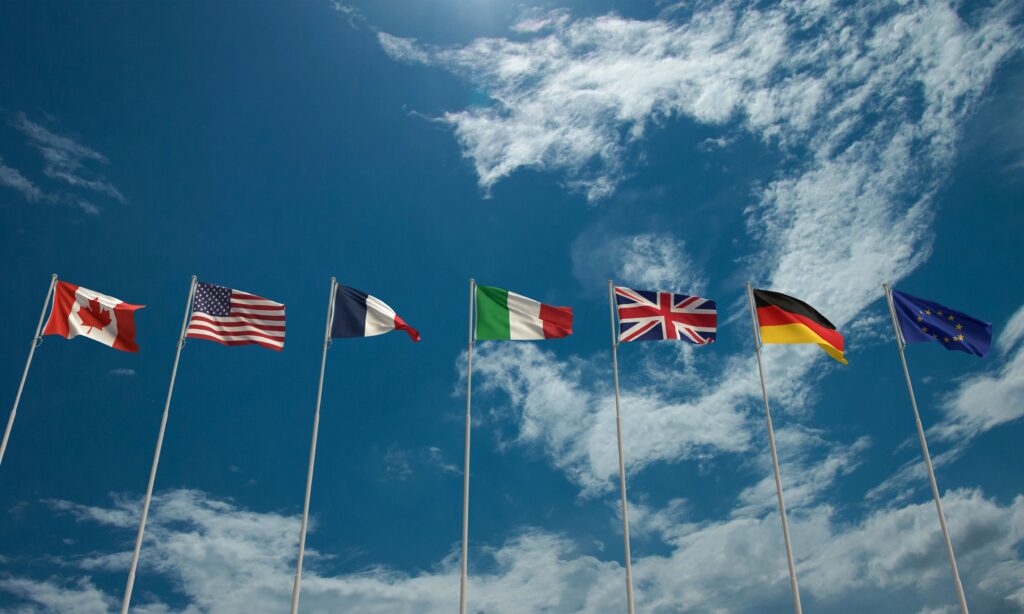
In an emerging world characterized by two competing blocs and continued interdependence, the G7 takes on heightened importance. Arguably, it has become America’s most important forum for coordinating strategy with its closest partners. The G7 brings together countries that share not only significant economic weight and technological capabilities, but also a common interest in preserving an international system grounded in openness, trusted relationships, and the rule of law.
The G7’s effectiveness has never rested solely on its economic size. Its strength lies in its ability to build consensus among leading democracies and chart a common direction in times of uncertainty. That ability is particularly vital in today’s world. While healthy disagreements among allies are inevitable, today’s geopolitical realities require G7 leaders to demonstrate at their meeting in Évian, France, that democratic nations remain capable of forging consensus and acting with purpose. The costs of fragmentation would extend far beyond the group, creating opportunities for competitors to exploit divisions and shape the emerging order in ways contrary to the interests of democratic societies.
At the same time, the G7 must recognize that strategic competition has evolved into a systems race. As Rachel Ziemba argues, strengthening cooperation on critical minerals through coordinated stockpiling, joint investment, and common approaches to economic security is essential to reducing vulnerabilities in strategically important supply chains. Likewise, as Klaus Larres notes, the G7’s Partnership for Global Infrastructure and Investment (PGII) requires greater focus, stronger execution, and additional resources if it is to provide a compelling alternative to China’s Belt and Road Initiative.
Critical minerals, infrastructure finance, advanced technologies, energy systems, and productive capacity are increasingly interconnected. The G7’s task is not to replicate China’s state-led model, but to align its considerable strengths—innovative companies, deep capital markets, trusted institutions, and enduring alliances—around a coherent strategic vision. The question is no longer whether democracies possess the resources to compete. It is whether they can organize themselves effectively enough to do so.
Expanding the G7’s Partnership for Global Infrastructure and Investment
By Dr. Klaus Larres, Richard M. Krasno Distinguished Professor, University of North Carolina, WISC Global Fellow
The Partnership for Global Infrastructure and Investment (PGII), created in 2022, is the G7’s major global infrastructure initiative. Together with the EU’s Global Gateway project and the resources provided by the U.S. International Development Finance Corporation (DFC), PGII is the Western world’s response to China’s Belt and Road Initiative (BRI). By next year, the G7 aims to obtain funding of some $600 billion in public and private capital for “sustainable, high-quality, and transparent development in low- and middle-income countries.”
While the G7 PGII initiative is still a work in progress, China’s BRI (created in 2013) has already mobilized more than $1.3 trillion in cumulative capital, investments, and construction contracts with more than 150 countries. Most of this money has come from Chinese state-controlled banks, such as the China Development Bank. The huge BRI initiative will be the elephant in the room at the 52nd G7 leaders’ summit in France in June 2026.
At the summit in Évian-les-Bains, the G7 countries need to make a concerted effort to push their PGII program and, above all, commit much more financial resources to it. In view of the huge rearmament effort in most G7 countries and the continuing increases in social welfare and health spending, many countries will be hesitant to put too much additional finance power into such an effort. So far, PGII resources largely consist of federal grants, revenue from export-import banks, and leveraged private sector investment.
In contrast to China’s BRI, the PGII initiative does not normally focus on stand-alone projects. Instead, the G7 focuses on interconnected economic corridors. Among them are the particularly important Lobito Corridor, which—in direct competition with China’s growing influence in Africa—connects the Democratic Republic of Congo and Zambia to the Port of Lobito in Angola to bolster critical mineral supply chains. The Luzon Economic Corridor focuses on the development of infrastructure and logistics in the Philippines, while the Trans-Caspian Transport Corridor is meant to improve connectivity between Europe and Central Asia, with the latter also increasingly being a focus of Chinese economic (and geopolitical) activities.
The G7’s infrastructure project PGII is a forward-looking initiative, yet it deserves greater focus and more financial resources if it is meant to seriously compete with China’s BRI. Ideally, G7 leaders will make decisions to this effect at their summit in France.
Building the Critical Minerals Architecture for Strategic Resilience
By Rachel Ziemba, DRI-WISC Affiliate
Critical minerals and supply chains are at the top of the G7 meeting agenda and remain among the key priorities for collaboration within the G7 and with like-minded countries. Key decisions to coordinate stockpiling, joint investment, and potential common tariffs should be taken soon to incentivize new production and give the private sector important signals. This meeting will be a key test as to whether the G7 can move beyond joint intent to create infrastructure and technocratic cooperation to seriously address the systemic vulnerabilities in the processing of critical minerals and rare earths. Setting up a critical minerals secretariat and empowering it with sufficient funds, government-level access, and cross-national prioritization would show they are serious.
Coordinating diverse stockpiling efforts across countries will be a key test. Most of the G7 and friends such as Australia have launched stockpiles either for military use or public-private efforts similar to operation Vault in the United States. These are important steps. The next phase will be to make clearer the circumstances under which businesses can access these stockpiles.
China’s weaponization of key mineral supply chains and restrictions in exports and investment in the space have reinforced the importance of these efforts. Progress has been made to address shortages in gallium, germanium, and lighter rare earths. New outbound investment limitations from China codify restrictions on the sharing of processing know-how.
The United States and countries such as Canada and G7 friend Australia are now more willing to invest and use their balance sheets in critical mineral investments, particularly to meet processing gaps. What’s less clear is how they coordinate with efforts from others—and if government investment is sufficiently transparent to allow joint investment.
Broader trade and investment policy should be clearer and more aligned. Chinese overcapacity is a common challenge facing the G7. US 301 tariff investigations aimed at driving revenues and onshoring should focus on areas where the United States can leapfrog development and invest for the future, rather than trying to replicate sectors of the past. In particular, common tariffs, export, and investment reviews should focus on their plausible national security challenges. United States tariffs aimed at supporting local production in autos and steel processing currently have the risk of undermining coordination, including a metals club that reduces tariffs for countries that commit to more restrictions on incoming low-cost steel and other supplies.
Author

Mark Kennedy
Director - Development Research Institute

Klaus Larres
WISC Global Fellow

Rachel Ziemba
DRI-WISC Affiliate