


The second SPP essay, built around the U.S. government’s transaction with MP Materials, concluded that strategic competition requires a deliberate allied architecture spanning capital, infrastructure, and industrial capacity. This article examines one of the earliest instances of that architecture taking institutional form: the restructuring of Syrah Resources, in which sovereign and allied institutional capital were deployed to rescue a strategically essential asset. Before turning to that transaction, it will examine how the prevailing definition of fiduciary duty has historically severed institutional capital from strategic purpose.
The purpose of this paper is not to argue that governments should direct capital indiscriminately or subordinate commercial judgment to political priorities. Rather, it examines how democratic societies can better align long-term strategic priorities and fiduciary responsibilities while preserving commercial discipline, accountability, and investor confidence.
This paper focuses specifically on the role of fiduciary duty within that architecture. Other questions—including how democratic societies establish strategic priorities and govern sovereign-private partnerships—are equally important but are beyond the scope of this paper.
Fiduciary Duty and the Severance of Strategic and Financial Returns
Modern states increasingly depend on private capital to secure critical infrastructure, supply chains, and industrial capability. Yet in liberal market economies, much of the capital ultimately owned by their citizens cannot legally or institutionally be deployed toward those objectives. Institutional capital is governed by fiduciary mandates that recognize financial interest but largely exclude sovereign strategic interest.
This creates a striking institutional paradox. The investors best positioned to finance long-duration strategic assets are often themselves public institutional investors. State-administered pension funds and sovereign wealth vehicles are large enough to invest at strategic scale, possess investment horizons measured in decades, and are structurally patient in ways that closely match the capital cycle of infrastructure and industrial development. In principle, they should be the natural funding base for sovereign-private partnerships.
In the United States, such institutions have largely been absent as instruments of strategic purpose. The obstacle is not a shortage of capital, nor an inherent conflict between commercial discipline and national interest. It is a legal and institutional framework that has defined fiduciary duty so narrowly that these institutions are unable to recognize or operationalize the strategic stakes in the capital they steward.
The prevailing definition of fiduciary duty—that institutional capital exists solely to maximize risk-adjusted returns for its beneficiaries—was constructed through a sequence of legal and intellectual moments that hardened into one particular answer to a genuinely contested question on capital management. In 1919, the Michigan Supreme Court ruled in Dodge v. Ford that a corporation exists primarily to benefit its shareholders, not to advance broader social objectives. The ruling’s legal scope was narrow; its ideological reach was not. In 1974, ERISA embedded the same logic into American pension fund governance, requiring trustees to act solely in the financial interest of beneficiaries.[1] Strictly interpreted, that standard rendered any consideration beyond return maximization a potential breach of duty, exposing trustees to legal liability. Milton Friedman had given the premise its philosophical formalization—any executive who deploys capital toward social or strategic objectives is spending other people’s money without their consent. Through legal precedent, legislation, and academic reinforcement, a contested set of propositions hardened into the professional definition of investment rationality itself.
The deeper consequence was epistemic. An entire generation of capital allocators—trained in efficient market theory and return-maximization as the sole legitimate objective—came to regard strategic purpose as a corruption of proper capital discipline rather than a legitimate input to it. This was embedded in credentialing systems, legal standards, and performance metrics. Portfolio managers who actively pursue sovereign or political alignment in an investment decision were not just philosophically heterodox. They were professionally and legally exposed.
The structural limitation this produces becomes clear when the full chain of beneficial interest is traced:

At every instance above the LP mandate, the interests are explicitly social and sovereign. A pension fund exists to fund workers’ retirements. A sovereign wealth fund exists to steward national assets on behalf of citizens. At the point of LP commitment, that logic severs. The operative mandate becomes return maximization, stripped of any strategic dimension. Every intermediary below (from fund managers to the companies they invest in) is legally bound to that same narrow mandate.
The result is a structural misalignment between where capital comes from and what it is permitted to do. A pension beneficiary whose savings are optimized in isolation—but who lives in a country that has lost control of its critical mineral supply chains, energy infrastructure, or digital networks—is not well served by that optimization. The financial return and the strategic interest have been institutionally severed, not because they are inherently in conflict, but because modern capital markets were built on the assumption that they should be treated as separate concerns. Under conditions of strategic competition, that premise has become an acute liability. Sovereign-private partnerships seek to undo that institutional separation—not by subordinating financial discipline to strategic objectives, but by designing investment structures in which achieving one reinforces the other. Effectively structured sovereign-private partnerships can preserve fiduciary discipline while also restoring alignment with national objectives.
The Syrah Resources restructuring is an early and instructive instance of that logic extended to allied institutional capital—a distressed strategic asset, rescued by a layered capital stack in which Australia’s largest superannuation fund sits alongside two U.S. government agencies as co-principals.
The Syrah Strategic Balance Sheet Restructuring
The MP Materials transaction demonstrated that strategic and financial alignment can be engineered into a bilateral deal between a sovereign and a domestic commercial entity. The U.S. government’s March 2026 transaction with Australia’s Syrah Resources extends that logic into more complex territory—a distressed foreign-listed company, a multi-sovereign capital stack spanning two U.S. agencies and an allied institutional investor, and instruments designed to rescue a strategically essential asset that Chinese price suppression had rendered commercially unviable.
Syrah is the only graphite producer operating a large-scale, vertically integrated supply chain outside China—from mine to finished anode material. It owns Balama in Mozambique, one of the world’s largest high-grade graphite deposits, and Vidalia in Louisiana, the only commercial-scale natural graphite Active Anode Material (AAM) facility in the United States. Graphite is the dominant anode material in lithium-ion batteries, and its supply chain—from mining to processing—runs overwhelmingly through China. A collapse in graphite prices—from $3,650 per metric ton in 2022 to some $1,800 by 2024, driven by Chinese synthetic graphite overcapacity—had stranded Syrah’s revenue base and pushed the company toward insolvency.
By late 2025, Syrah had triggered events of default on loans from the U.S. International Development Finance Corporation (DFC) and the U.S. Department of Energy (DOE)—both of which had provided financing to develop Balama and Vidalia—held only $18 million in unrestricted cash, and had received a going-concern qualification from its auditors. Tesla had served a default notice on its offtake agreement. Without intervention, Syrah faced insolvency and with it, the loss of the only integrated ex-China graphite-to-anode supply chain in the Western hemisphere. The government’s task was to perform a strategic balance sheet restructuring—preserving a critical asset that capital markets alone would have allowed to fail.
The proposed solution was a layered instrument stack designed to restructure Syrah’s defaulted capital structure, secure sovereign equity stakes, create conditional liquidity facilities, and embed strategic governance rights across three principals (DFC, DOE, and AustralianSuper).
AustralianSuper as Allied Institutional Capital
The most consequential feature of the structure is the role of AustralianSuper—Australia’s largest superannuation fund and Syrah’s largest shareholder. Unlike a sovereign wealth fund, AustralianSuper is neither state-owned nor expressly mandated to pursue national strategic objectives. It is a commercially managed retirement fund built on Australia’s compulsory superannuation system, bound by fiduciary obligations to its members that are, if anything, more stringent than the ERISA standard governing many U.S. pension funds. Yet its long-duration mandate, its national context, and its alignment with allied critical minerals policy place it in a category distinct from ordinary private capital—what might be called quasi-sovereign or allied institutional capital—commercially disciplined, fiduciary-bound, yet capable of operating as a strategic partner alongside sovereign actors.
This is the fiduciary argument of the previous section inverted into a solution. AustralianSuper’s participation does not require its fiduciary duty to be relaxed or overridden in service of strategic objectives. Rather, the transaction is structured so that the two are the same act. The recapitalization delivers a strategic outcome—preserving an allied graphite supply chain—while simultaneously creating a credible path to equity appreciation should Vidalia achieve commercial scale. AustralianSuper functions as a conduit of allied strategic intent while remaining a disciplined fiduciary for its members. Fiduciary duty is not being compromised. It is being reconstituted—embedded with strategic rationale while preserving its financial logic.
That reconstitution is the broader significance of the transaction. If a retirement fund bound by strict fiduciary standards can participate as a strategic co-principal without breaching those standards, then the apparent divide between financial and strategic interest is a consequence of institutional design choice, not an immutable feature of capital markets. That gap can be narrowed through capital structure. AustralianSuper may represent an emerging category: not a sovereign wealth fund, but an institution capable of embedding national strategic logic within a commercially disciplined investment mandate.
Restructuring Improves Syrah’s Commercial Prospects
Like the MP Materials transaction, each instrument is designed to raise the likelihood that the asset becomes commercially viable. The conversion of defaulted debt into equity-linked instruments eliminates near-term cash debt service, preserving operating capital for the Vidalia ramp-up. The three-year runway with Payment-in-Kind (PIK) capitalization, rather than cash interest, removes the immediate liquidity pressure that would otherwise force a distressed sale or liquidation. The conditional secondary liquidity facility insures against operational shortfalls during ramp-up. The DOE forbearance ties relief to production milestones, disciplining execution. And the U.S. secondary listing trigger creates a defined path to public market validation and capital access. Sovereign support does not simply rescue the asset, it re-rates it, raising the probability of the commercial outcome on which every principal’s financial return depends. The illustrative market capitalization rises from US$218 million at the equity-raise stage to US$664 million at financial close, reflecting both the conversion of debt to equity and the re-rating that sovereign de-risking is expected to unlock.
The full structure instrument by instrument
| Instrument | Sovereign Benefit | Allied Institutional Benefit | Private Benefit | |||
| DFC | DOE | AustralianSuper | Syrah | |||
| DFC debt-for-equity swap ($31M, ~20 percent stake) | Strategic equity stake in only integrated ex-China graphite-to-anode supply chain; board nomination rights; anti-dilution protection at 9.95 percent minimum. | — | — | Eliminates $31M loan obligation; government anchor stake crowds in private capital and signals strategic validation. | ||
| DFC warrant package (~5 percent fully diluted) | Deepens equity alignment at near-zero cost; ties DFC package to Syrah’s long-term equity performance. | — | — | Nominal cost; cements DFC as structural partner rather than mere creditor. | ||
| Primary Convertible Loan Notes (CLNs) ($232M total) | $57M: Converts defaulted loan to patient equity-linked instrument; no cash debt service for three years; board observer rights. | $40M: Converts defaulted loan to secured CLN; milestone conditionality preserved; board observer rights. | $134M: Existing notes reissued as CLN at updated conversion price; allied capital remains structurally committed. | Eliminates near-term debt service across entire capital structure; 11 percent PIK capitalizes rather than consuming cash; operating capital preserved for ramp-up of Vidalia AAM facility. | ||
| Secondary CLNs ($68M conditional) | $30M at sole DFC discretion for Balama; preserves leverage over operational milestones. | — | $38M; $28M committed within six months across Balama, Vidalia, and corporate. | Up to $198M pro forma liquidity; no immediate draw obligation; insurance against operational shortfalls during ramp-up. | ||
| DOE extended forbearance (to April 2029) | — | Defers default enforcement in exchange for milestone conditionality—Tesla qualification by December 2026, full production by May 2027. | — | Eliminates near-term default risk on $95M DOE loan; operational runway to achieve commercial AAM sales. | ||
| US secondary listing trigger (50 percent CLN conversion) | Converts half of DFC CLNs to equity at point of public market validation; participates in upside at market-recognized value. | Converts half of DOE CLNs to equity on same terms. | Converts half of AustralianSuper CLNs to equity on same terms. | Defined path to capital markets access; listing requirement disciplines timeline toward commercial viability. | ||
| Board governance rights | Observer immediately; one director at 9.95 percent; two directors at 20 percent. | Observer immediately; one director at 9.95 percent; two directors at 20 percent. | One director at 9.95 percent; two directors at 20 percent. | Government and allied institutional board presence signals strategic backing to commercial counterparties, lenders, and offtake partners. | ||
Evolution of Syrah’s ownership structure
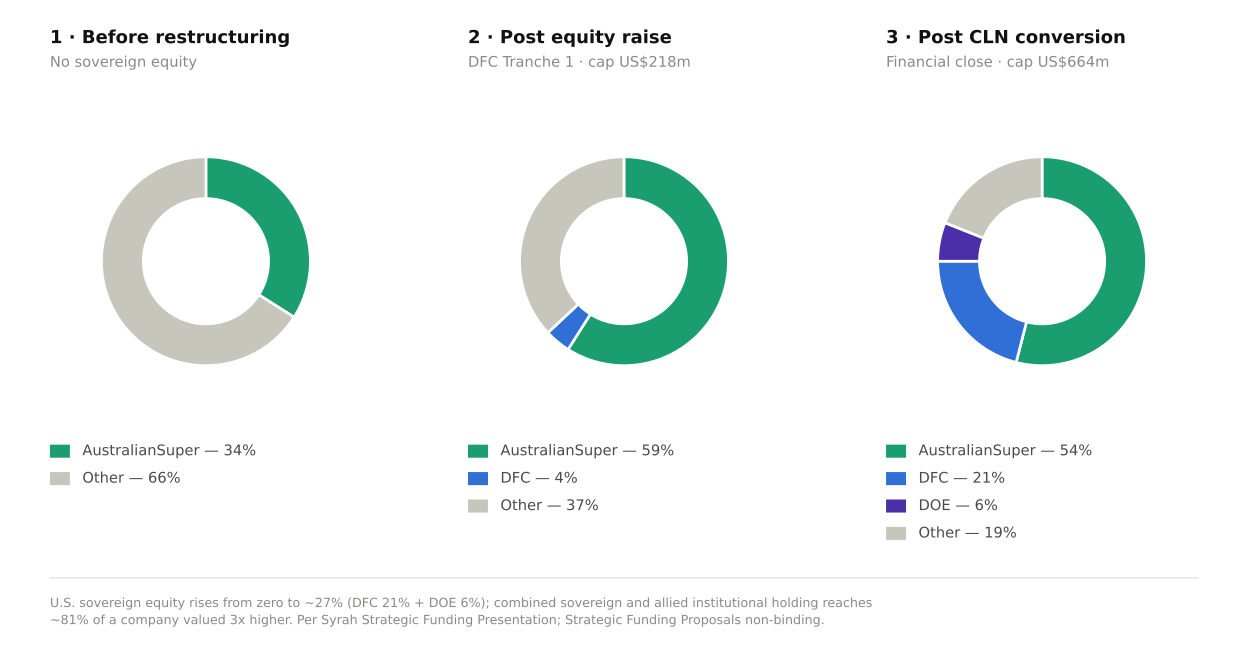
The Transformation of Fiduciary Logic under Government Equity
The proposed restructuring does not merely recapitalize Syrah, it reshapes its ownership. On full conversion, AustralianSuper would hold a majority equity position, with the DFC at roughly 21 percent and the DOE at 6 percent—and each of these stakes carries board nomination rights, scaling from an observer seat to two directors at a 20 percent holding. The U.S. government would not simply be a creditor made whole or a passive shareholder awaiting a return. It would sit in the boardroom, through directors it appoints, with a standing claim on the company’s strategic direction.
This is where the equity stake transforms the fiduciary rationale. Directors nominated by the DFC or DOE do not represent diffuse public shareholders seeking financial return; they represent a sovereign whose interest in the asset is strategic by definition. Their presence does not impose national security objectives from outside the governance framework. Rather, those objectives enter the boardroom through the legitimate interests of a shareholder that the board owes fiduciary duties to, alongside every other shareholder. Strategic considerations are no longer external constraints on corporate decision-making. They become part of the shareholder landscape to which fiduciary governance must respond.
A broader implication extends beyond Syrah. Government equity ownership does not require abandoning shareholder primacy. It changes the identity of the shareholder. The logic of Dodge v. Ford remains formally intact—a corporation exists to serve the interests of its shareholders—but one of those shareholders is now a sovereign for whom financial return and strategic resilience are inseparable. As governments increasingly become long-term equity holders in strategically significant firms, fiduciary governance may evolve not because its legal foundations have been displaced, but because the interests represented within the shareholder base have fundamentally changed.
Embedding Strategic Intent in Institutional Capital
The Syrah transaction’s architecture demonstrates something the prevailing account of fiduciary duty forecloses—that institutional capital can be deployed toward sovereign strategic ends without abandoning the financial discipline it owes its beneficiaries. AustralianSuper does not compromise its fiduciary duty to participate as a strategic co-principal. It satisfies that duty and advances an allied objective at the same time.
The severance of strategic and financial interest—the divide that runs through much of the architecture of Western institutional capital—is revealed not as a law of markets but as a design choice. And what was designed can be redesigned. The MP Materials transaction showed that alignment could be engineered into a bilateral deal between a sovereign and a domestic firm. Syrah shows that the same logic extends across borders and across the capital stack—that allied institutional investors operating under rigorous fiduciary standards can participate alongside sovereign agencies as co-principals in a shared strategic asset.
The significance of the Syrah restructuring therefore extends well beyond a single graphite producer or a single balance sheet. It suggests that the institutions governing long-duration capital need not force a choice between fiduciary discipline and strategic purpose. Through carefully structured ownership, governance, and incentives, allied institutional investors can pursue both simultaneously. As strategic competition increasingly depends on the ability to mobilize public and private capital at scale, the challenge is not merely to finance strategic assets. It is redesigning the institutions that govern capital itself. If the separation of strategic and financial interests was a design choice, then so too is their reintegration.
[1] ERISA emerged partly in response to genuine abuses—pension trustees making investments based on political connections and personal favors at the expense of beneficiaries. In that context, the narrow mandate was a legitimate corrective. But the solution to one structural problem created another. By legally severing fiduciary duty from any purpose beyond return maximization, it rendered institutional capital constitutionally unable to recognize its own strategic interest—a liability that was tolerable in an era of globalization and stable flows of goods/capital but has become acute in an era of strategic competition.

Mark Choi
Mark Choi is a finance and policy professional focused on infrastructure, strategic investment, and development finance. He is also a U.S. Navy veteran.