

2026 AI and the Workforce Conference: Keynote Panel of University Presidents
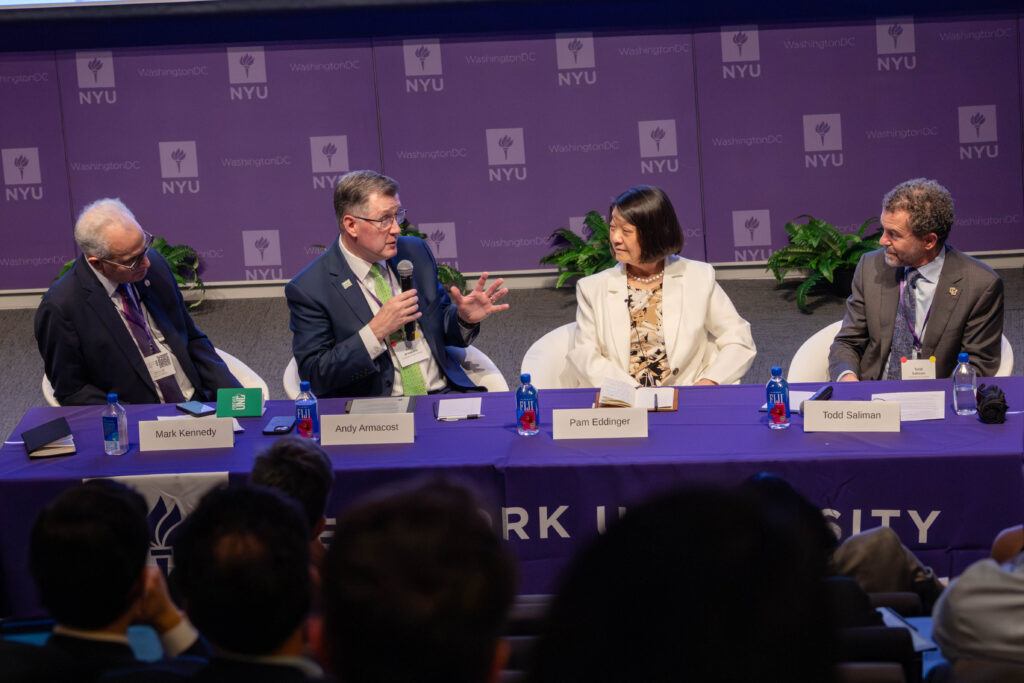
The following summarizes key insights from a panel discussion on “Preparing Talent for the AI Economy” at the NYU AI and the Workforce Conference with President Andrew Armacost of the University of North Dakota, President Pam Eddinger of Bunker Hill Community College, and President Todd Saliman of the University of Colorado, moderated by NYU DRI and WISC Director Mark Kennedy.
Preparing Talent for the AI Economy
AI isn’t ultimately a competition for the best models or the fastest chips. The winners—whether individuals, organizations, or nations—will be those that develop the talent to build, deploy, and use AI most effectively. That’s why universities are at the center of the AI economy.— Mark Kennedy, Director of NYU DRI and WISC
America’s colleges and universities drive the nation’s innovation economy, providing the research and skilled talent necessary to maintain a global competitive edge.
However, the rise of artificial intelligence presents higher education with a paradox. While AI can expand educational access and personalize learning, it also generates deep concerns about job displacement, institutional inequality, outdated curricula, and data security.
To manage this paradox, campuses are already taking system-wide action across both classrooms and university governance. These efforts, complemented by closer private sector partnerships and robust funding, will help ensure successful adoption to maintain America’s competitive edge.
Opportunities and Challenges
AI has the potential to make higher education more accessible. Personalized learning platforms can adapt instruction to different learning styles and schedules, helping the full range of traditional students, adult learners, working professionals, and underserved communities gain critical skills and knowledge. AI also enables immersive learning through simulations and virtual training environments.
Universities can leverage these innovations to prepare students for labor market that increasingly demands continuous learning rather than a single degree earned early in life. By enabling students to acquire new skills efficiently throughout their careers, institutions can ensure graduates are better prepared to adapt as technology transforms the labor market.
We need a system-wide conversation about how to engage in the AI space… It’s really important to listen to the community and meet them where they are at. – Todd Saliman, President of the University of Colorado
At the same time, challenges persist. The rapid rise of generative AI has left many students questioning whether their planned professions will be significantly automated before—or soon after—they graduate. This uncertainty can undermine motivation and raise doubts about whether the financial and personal investment in a college degree will continue to provide a strong return.
AI also risks widening existing inequalities across higher education. Building secure AI infrastructure, licensing enterprise-grade software, and training faculty require substantial financial resources. Wealthier institutions are better positioned to provide students with sophisticated AI tools and protected computing environments.
AI is 20% technology adoption and 80% change management. – Pam Eddinger, President of Bunker Hill Community College
Beyond its applications to teaching, institutions are exploring ways AI can support administration, research, and student services. While these applications improve efficiency, they introduce risks involving intellectual property and sensitive student data. Protecting this information while responsibly adopting AI has become a central governance challenge.
Strategic Responses
Preparing for an AI-enabled future requires proactive leadership. Rather than waiting for the labor market to stabilize, many campuses are already pursuing three complementary strategies.
First, institutions are strengthening AI governance. AI has not changed the need to meet existing legal and ethical obligations, including protecting student records. Therefore, effective adoption requires clear policies governing data security and privacy.
We are making an active effort to demystify what it means to teach in an AI world. – Andrew Armacost, President of the University of North Dakota
Second, universities are rethinking instruction and assessment. Traditional forms of assessment, like end-of-term essays, are no longer sufficient measures of learning. Faculty are shifting toward assessments that evaluate the learning process, using oral examinations, live problem-solving, and collaborative projects to encourage students to use AI thoughtfully.
Hands-on instruction, including apprenticeships and internships, help students close skills gaps and open new opportunities. – President Todd Saliman
Third, successful implementation depends on broad campus engagement. AI policies imposed solely from the top are unlikely to succeed. Faculty, students, and administrators must work together to develop shared expectations through transparent communication, professional development, and collaborative policymaking. Building trust is just as important as deploying new technology.
Preparing Tomorrow’s Students
Institution- and system-wide efforts are providing the necessary structures for effective AI adoption. At the same time, colleges and universities are developing new instructional techniques to ensure that students graduate with the capabilities needed to thrive in an AI-enabled economy.
Experiential learning is increasingly valuable. Apprenticeships, internships, clinical placements, undergraduate research, and project-based learning help students develop skills that remain difficult to automate, including leadership, communication, teamwork, ethical judgment, and complex problem-solving. These experiences also help students understand where AI enhances human expertise rather than replaces it.
Students must understand the emerging technologies in the chosen fields… and that means greater AI literacy and more hands-on experience with AI tools. – President Andrew Armacost
AI literacy is likewise becoming a part of core curricula. Students in business may need to evaluate AI-assisted market analyses, journalism students should learn to verify AI-generated content, and nursing students must understand both the capabilities and limitations of clinical decision-support systems. Graduates should leave with the ability to select appropriate AI tools, write effective prompts, critically evaluate AI-generated outputs, and recognize the ethical responsibilities associated with their use.
Achieving these goals requires stronger partnerships between higher education and industry. Universities need continuous feedback from employers to understand how AI is reshaping occupations and which competencies are becoming most valuable. More agile collaboration can help academic departments update curricula, expand internship opportunities, and better align educational programs with evolving workforce needs.
We have an extraordinary opportunity for the people we serve to use AI as a tool for innovation and creativity – President Todd Saliman
Finally, institutions are starting to rethink the traditional four-year degree as the sole pathway for workforce preparation. As technology evolves more rapidly, workers will increasingly need opportunities to reskill throughout their careers. Micro-credentials, professional certificates, and digital badges offer flexible pathways for acquiring new competencies without requiring a return to a full degree program. Rather than replacing bachelor’s degrees, these credentials can complement them by supporting lifelong learning in a rapidly changing economy.
Looking ahead
Adapting to the AI economy is neither fast nor free. The traditional academic curriculum review cycle takes years, making it fundamentally incompatible with a technological landscape that evolves month by month. At the same time, many public and mid-tier private universities operate on razor-thin margins and lack the capital required to build secure AI networks, hire top-tier data scientists, or continuously retrain faculty.
Getting education right is a public service…but if you love it, fund it. – President Pam Eddinger
Despite the challenges, managing this transition remains essential. Effective adoption of emerging technologies is a fundamental customer service to tuition-paying students and a critical public service to society at large. If higher education fails to adapt, the workforce will face unprecedented disruption.
The recent past shows us the opportunities for new job creation and opportunities for our students. – President Andrew Armacost
To prevent this failure, higher education leaders must issue a collective call to action: success in the AI era cannot be achieved by universities acting in isolation. It demands federal, and potentially private, funding to subsidize the necessary transition in academic AI infrastructure and research.
It also requires new levels of integration with the private sector. Closer partnerships allow universities to receive real-time feedback from employers, ensuring curricula evolve at the same rapid pace as technological innovation. By integrating industry insights into the classroom, institutions can replace abstract theory with hands-on, experiential learning opportunities like internships and joint projects. This direct alignment ensures that graduates enter the workforce already possessing the specific, practical competencies that modern employers actively demand.
Preparing talent for the AI economy is not simply an educational challenge. It is a national competitiveness challenge. Universities, employers, and government each have indispensable roles, but none can succeed alone. America’s long-term advantage will depend less on inventing AI than on preparing people to use it wisely.
Summary of panel discussion provided by Dr. Jeffrey Kucik.

Andrew Armacost
President of the University of North Dakota

Pam Eddinger
President of Bunker Hill Community College

Todd Saliman
President of the University of Colorado

Mark Kennedy
Director - Development Research Institute