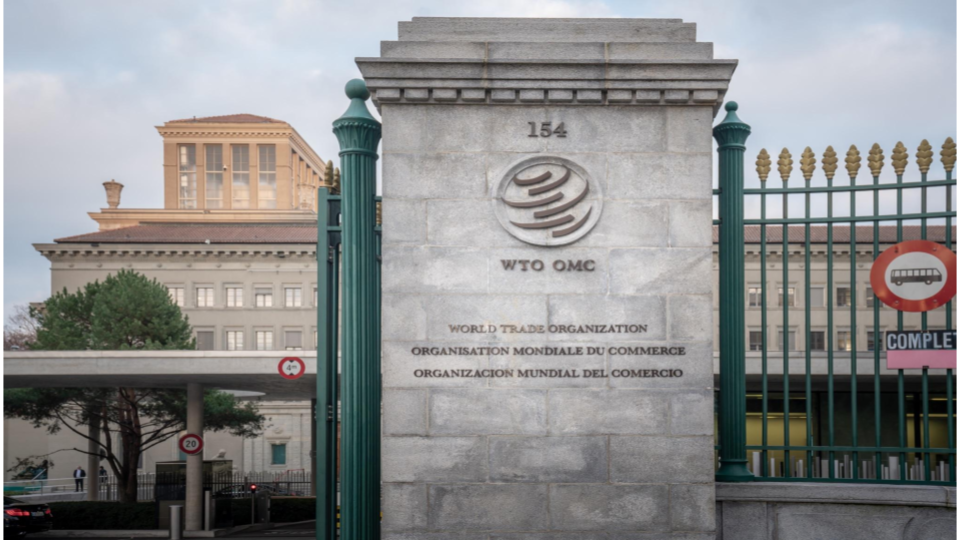

Building the Institutions of Strategic Capital
Building the Institutions of Strategic Capital
The following insights emerged from a WISC roundtable with senior leaders from government, finance, industry, academia, and think tanks. Held under the Chatham House Rule, they examined how democratic societies can mobilize capital at strategic scale. The old economic playbook in democratic economies drew a strict boundary between public governance and private capital. State intervention […]
Learn MoreThe Architecture of Trust
The Architecture of Trust
Policymakers typically frame artificial intelligence competition as a race to build the latest and greatest models. But the next phase of geopolitical competition will be won by the coalition of countries that successfully deploys the most trusted ecosystem at scale—one anchored in physical infrastructure such as energy grids and telecommunications systems, as well as financing, […]
Learn MoreStructuring the Sovereign-Private Partnership: Delivering Both Strategic and Financial Returns
Structuring the Sovereign-Private Partnership: Delivering Both Strategic and Financial Returns
A previous essay introduced the concept of the sovereign-private partnership (SPP) as a response to a structural shift. In an era where infrastructure has become an important facet of statecraft, capital can no longer be deployed for yield alone. The SPP offers a framework in which private execution advances national strategic objectives, without abandoning the […]
Learn MorePorts of Power
Ports of Power
Ports are no longer just commercial gateways — they are strategic assets that shape supply chains, alliance cohesion, and geopolitical leverage. Ports of Power examines how long-duration infrastructure finance, ownership structures, and operational control influence global competition in an era of intensifying geoeconomic rivalry. The report analyzes the strategic implications of port investment and governance […]
Learn MoreAI Is Infrastructure, Not Software
AI Is Infrastructure, Not Software
Artificial intelligence is still widely discussed as if it were software. A breakthrough model is released. Benchmarks are compared. Capabilities are debated. New applications appear overnight. The story feels familiar — like the rise of mobile apps or cloud platforms. Fast. Iterative. Borderless. But that framing is increasingly misleading. Artificial intelligence has crossed a threshold. […]
Learn MoreAmerica’s Private-Capital Advantage – How to Outcompete Chinese State Capitalism
America’s Private-Capital Advantage – How to Outcompete Chinese State Capitalism
Learn MoreWhy America Struggles to Compete on Global Infrastructure
Why America Struggles to Compete on Global Infrastructure
The United States has awakened to the reality that supporting international infrastructure is no longer just a development issue. Infrastructure—digital networks, energy systems, and ports—is now central to strategic competition. Washington has responded. The U.S. International Development Finance Corporation (DFC) has expanded its authorities, in line with recommendations we advanced. The Export-Import Bank of the […]
Learn MoreA Stronger DFC for a Freer, More Open World
A Stronger DFC for a Freer, More Open World
The Trump administration’s recently released proposal to reauthorize and expand the U.S. International Development Finance Corporation (DFC) reflects many of the recommendations we advanced last year at the Wahba Institute for Strategic Competition (WISC) on how to activate American investment overseas for a freer, more open world. We commend the administration for moving decisively in […]
Learn MoreBuilding Digital Trust Together
Building Digital Trust Together
Part of my Mind the Gap and Innovative Imperative series on strategic competition in technology. Around the world, nations are racing to build the digital foundations of their economies — connecting citizens, powering innovation, and modernizing essential services. What’s at stake is not simply who leads in artificial intelligence or semiconductors, but who shapes the architecture of the […]
Learn More360° View of a US Sovereign Wealth Fund
360° View of a US Sovereign Wealth Fund
For Want of a Nail Mark Kennedy Director, Wahba Institute for Strategic Competition, Wilson Center The proverb reminds us that “For want of a nail, the kingdom was lost.” Today, the United States faces mounting risks from the metaphorical lack of a nail—inadequate equity investment that could activate other capital to secure global investments critical […]
Learn MoreEmbracing Infrastructure Finance as Vital Tool in Strategic Competition
Embracing Infrastructure Finance as Vital Tool in Strategic Competition
Learn MoreReauthorizing DFC in Lame Duck Period Avoids Disrupting an Important Foreign Policy Tool
Reauthorizing DFC in Lame Duck Period Avoids Disrupting an Important Foreign Policy Tool
\\The US International Development Finance Corporation (DFC) was created in December 2019 after President Donald Trump signed into law the BUILD Act in October 2018. In the five years since, it has become one of America’s most effective tools for building geopolitical relations and advancing foreign policy priorities. The incoming Secretary of State will want […]
Learn MoreCan the U.S. Keep China from Disrupting U.S. Ocean Shipping?
Can the U.S. Keep China from Disrupting U.S. Ocean Shipping?
Learn MoreAmerica’s Maritime Blind Spot: How China is Gaining the Upper Hand on the High Seas
America’s Maritime Blind Spot: How China is Gaining the Upper Hand on the High Seas
For decades, the US has taken the security of global sea lanes for granted, assuming that commercial and military shipping would always function smoothly. But while America remained complacent, China methodically expanded its maritime dominance, ensuring the steady flow of its own cargo while developing the capability to disrupt American supply chains at will. Chinese […]
Learn MoreBlended Finance and Capital Mobilization
Deploying public, private, and multilateral capital through blended structures that accelerate infrastructure delivery while reducing risk and attracting sustained investment.
Project Preparation and Execution Capacity
Strengthening project pipelines, regulatory frameworks, and execution capabilities to move infrastructure from concept to deployment with speed, transparency, and reliability.
Digital and AI-Enabling Infrastructure
Financing data centers, fiber networks, and cloud infrastructure that enable AI deployment, support digital economies, and anchor long-term technological competitiveness.
Resilient Logistics and Trade Corridors
Investing in ports, rail, and supply chain infrastructure that secure trade flows, reduce chokepoint vulnerabilities, and enable rapid system deployment across regions.
Energy Systems for Industrial and Digital Scale
Building scalable, reliable energy systems—grids, nuclear, LNG, and renewables—that power industry, compute, and infrastructure while reducing strategic dependence.
Content




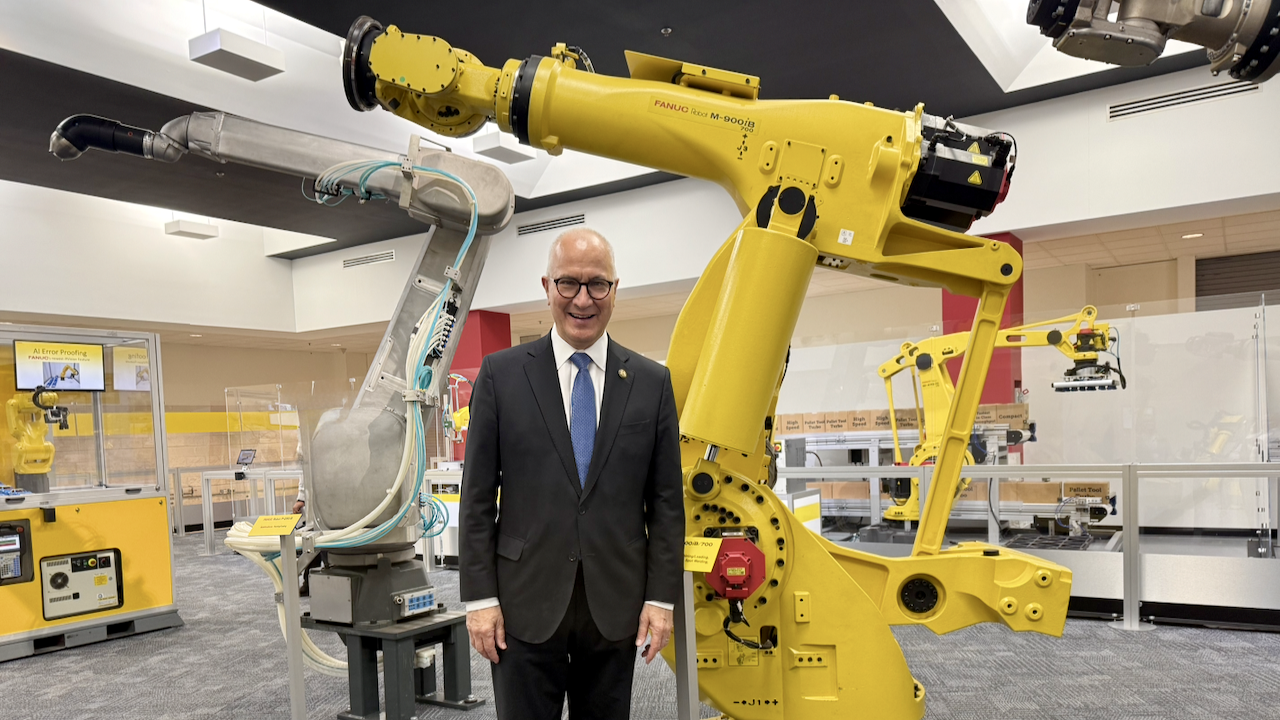
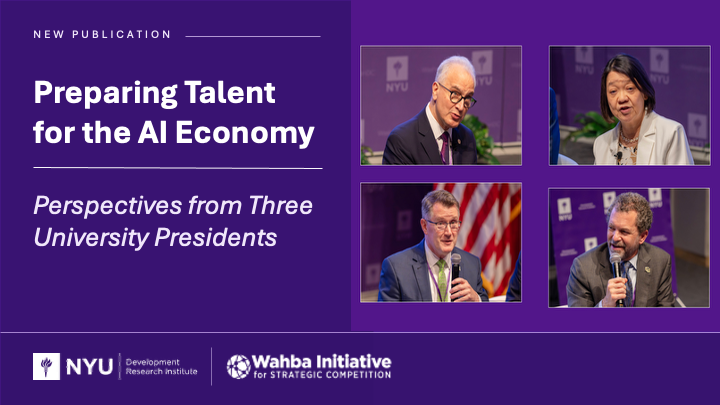
Preparing Talent for the AI Economy: Perspectives from Three University Presidents
Learn More
by Andrew Armacost, Pam Eddinger, Todd Saliman, Mark Kennedy
September 21, 2026