

Silicon Valley invents. Shenzhen makes. America needs to excel at both — and connect them.
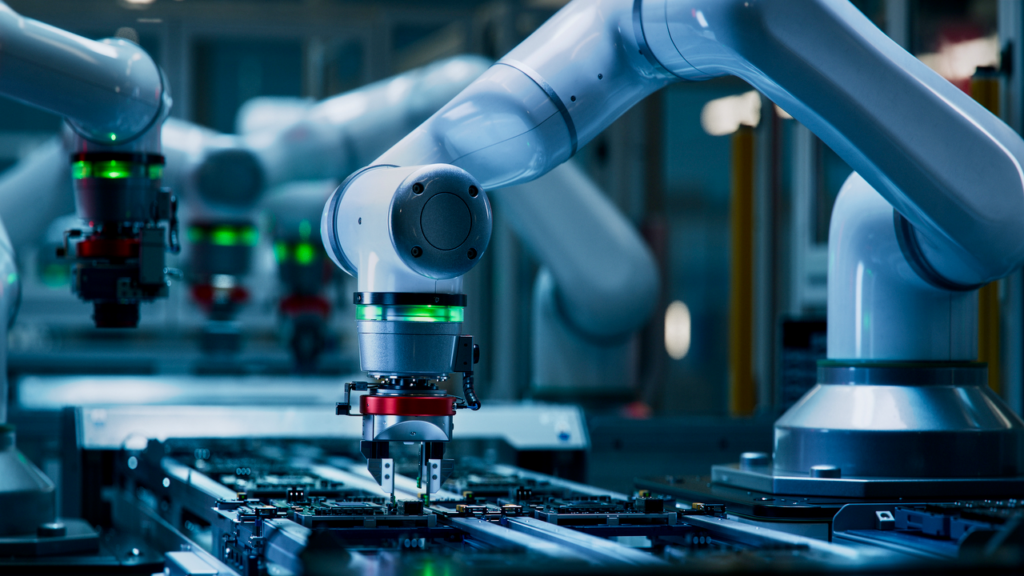
I recently visited FANUC America Corporation’s robotics campus in Rochester Hills, Michigan, and found myself thinking of an old Disney song. In “The Happiest Millionaire,” a young suitor can’t wait to get back to Detroit — automobiles, industry, the excitement of making things. More than half a century later, standing among FANUC’s robots, I found myself asking whether Detroit could again become one of the places where America’s industrial future gets made.
I have made a version of that pilgrimage before. As a University of Michigan MBA student, I toured the Detroit Institute of Arts, the Henry Ford Museum, and General Motors’ former New Center headquarters and came away with the same impression: the gleam that captivated that movie’s young suitor was still visible with a little imagination, but preserved more in museums than in daily production. Standing in FANUC’s technical training center, the FANUC Academy, I found myself wondering whether that gleam is returning.
America’s competition with China is usually framed as a race to invent the technologies of the future. It is also a race to turn those technologies into productive capacity at scale — and those are not the same skill. Dan Wang’s Breakneck crystallized something I had been circling: Silicon Valley built an extraordinary ecosystem for invention; Shenzhen built a different kind of density — engineers, suppliers, and skilled workers clustered together, constantly turning ideas into physical products. Put simply, Silicon Valley figures out what to invent; Shenzhen figures out how to make it. America needs to excel at both, and we do not need to recreate Shenzhen to do it — we once had our own version of that density. It was Detroit.
FANUC America itself makes the case. While some products are made by its parent company, FANUC Corporation in Japan, FANUC America has built over two million square feet of facilities in Michigan, with recently announced plans for further expansion to provide robotics manufacturing capabilities in the U.S. Moreover, FANUC America has converted a former law school in metro Detroit into what its CEO calls the largest corporate robotics and automation training facility in the United States. I walked through what used to be the law school’s classrooms and library, now lined with industrial robots, watching students work the equipment themselves rather than reading about it. What struck me was not the robots — it was everything required to make them productive: applied engineers, technicians, systems integrators, instructors, and the community colleges and universities that supply them.
One executive put a number on the imbalance that should worry any strategist: for every research engineer the industry needs, it needs roughly ten applied engineers and fifty to a hundred technicians to install, integrate and maintain the equipment. A policy that funds the invention and ignores that workforce buys machines, not capacity. FANUC America has long been at the forefront of robotics training and partnering with schools, but its FANUC Academy demonstrates there is so much more that can be done to develop a future workforce for world-class manufacturing.
That many of FANUC’s robots are Japanese is itself instructive. The United States leads in AI, compute and capital; Japan leads in robotics, machine tools and precision manufacturing; China can integrate both inside one national system. As I’ve argued elsewhere, mineral security is a systems problem, not a sourcing problem — the same is true of robotics. An American company training American workers in Michigan on Japanese advanced technology is not simply utilizing foreign technology. It squarely demonstrates the connective tissue an allied industrial system needs.
Detroit does not need to become Silicon Valley, and America does not need to become Shenzhen. What it needs is to connect the places that invent to the communities that know how to build — and to do the same with trusted allies who hold complementary strengths. The harder questions are what that connective architecture should look like—and which of America’s accumulated capabilities need to scale fastest. Those are the questions WISC’s Productive Capacity research is designed to explore.
Author

Mark Kennedy
Director - Development Research Institute