

Featured
Give the AI Export Program What It Needs to Win
Give the AI Export Program What It Needs to Win
In 90 days, the Commerce Department’s American AI Exports Program persuaded companies that normally sell separate—and sometimes competing—parts of the artificial intelligence stack to assemble 78 proposals for exporting complete American-led AI systems. The packages span hardware, data, models, cybersecurity, and sector-specific applications. That response is a remarkable show of private-sector readiness. It is not […]
Learn MorePreparing Talent for the AI Economy: Perspectives from Three University Presidents
Preparing Talent for the AI Economy: Perspectives from Three University Presidents
New Publication | Preparing Talent for the AI Economy: Perspectives from Three University Presidents Building on the 2026 NYU AI and the Workforce Conference, this new publication brings together the perspectives of three university presidents on how higher education must adapt as artificial intelligence reshapes learning, work, and the skills students will need throughout their […]
Learn MoreThe AI Race Beyond Chips
The AI Race Beyond Chips
By David Yu, PhD, CFA, NYU Stern and Shanghai, DRI-WISC Affiliate The AI race is framed as one for chips, but access to them only grants permission to build. Financing contracts determine whether the actual capacity gets built and who really controls it. Shaping the global diffusion of AI requires treating capital formation alongside export […]
Learn MorePower Is the First AI Policy
Power Is the First AI Policy
For the past several years, the artificial intelligence debate has revolved around models. Which system is most capable? Which company is ahead? Which country controls the most advanced chips? Which rules should govern safety, bias, copyright, privacy, and national security? Those questions still matter. But they are no longer enough. AI has entered a different […]
Learn MoreThe Sovereignty Trap and Other Lessons
The Sovereignty Trap and Other Lessons
A note on sourcing: This roundtable was conducted under the Chatham House Rule. The summary below reflects the substance of the discussion only—no comment is attributed to any individual or to the organizations they represent. On June 4, 2026, NYU’s Wahba Initiative for Strategic Competition convened a private roundtable in Washington, D.C. on building allied […]
Learn MoreThe Architecture of Trust
The Architecture of Trust
Policymakers typically frame artificial intelligence competition as a race to build the latest and greatest models. But the next phase of geopolitical competition will be won by the coalition of countries that successfully deploys the most trusted ecosystem at scale—one anchored in physical infrastructure such as energy grids and telecommunications systems, as well as financing, […]
Learn MoreBuilding the Institutions of Strategic Capital
Building the Institutions of Strategic Capital
The following insights emerged from a WISC roundtable with senior leaders from government, finance, industry, academia, and think tanks. Held under the Chatham House Rule, they examined how democratic societies can mobilize capital at strategic scale. The old economic playbook in democratic economies drew a strict boundary between public governance and private capital. State intervention […]
Learn MorePreparing Talent for the AI Economy
Preparing Talent for the AI Economy
The following summarizes key insights from a panel discussion on “Preparing Talent for the AI Economy” at the NYU AI and the Workforce Conference with President Andrew Armacost of the University of North Dakota, President Pam Eddinger of Bunker Hill Community College, and President Todd Saliman of the University of Colorado, moderated by NYU DRI […]
Learn MoreMark Kennedy on the US–China Tech Race in Goldman Sachs Research’s Top of Mind
Mark Kennedy on the US–China Tech Race in Goldman Sachs Research’s Top of Mind
Learn MoreThe Global Competition for Dominance in Artificial Intelligence
The Global Competition for Dominance in Artificial Intelligence
While steam powered the 19th century and electricity defined the 20th, the prime transformative force shaping the 21st century is artificial intelligence (AI). It is the heartbeat of what Klaus Schwab, founder of the World Economic Forum, calls the “The Fourth Industrial Revolution,” a fusion of technologies blurring the boundaries between physical, digital, and biological […]
Learn MoreAmerica’s AI Exports Program Comments
America’s AI Exports Program Comments
Docket No. ITA-ITA-2025-0070 Section A — Respondent Background Identify and describe who you represent and explain why you are providing input to this RFI. The Wahba Initiative for Strategic Competition (WISC) is an applied policy and research initiative based at New York University’s Development Research Institute. WISC focuses on strategic competition, geoeconomic statecraft, technology governance, […]
Learn More360° View of Alliances: How They Benefit America—And How They Must Evolve
360° View of Alliances: How They Benefit America—And How They Must Evolve
Alliances at the Crossroads By Mark R. Kennedy, Founding Director, Wahba Initiative for Strategic Competition Alliances are America’s most underappreciated strategic asset. They extend our reach, multiply our capabilities, and give our actions legitimacy. They deter adversaries not only through collective military strength, but also by weaving together economic, technological, diplomatic, and cultural ties that […]
Learn MoreWho Writes the Digital Rules, Wins the Future
Who Writes the Digital Rules, Wins the Future
Writing rules for the digital economy is a balancing act. Everyone agrees that to derive the maximum benefit from the digital economy requires keeping obstacles to trade to a minimum. Yet, there is also a consensus that questions of national security, consumer protection and competition are of crucial importance. For political, economic and strategic reasons […]
Learn MoreResearch, Publications, and Insights



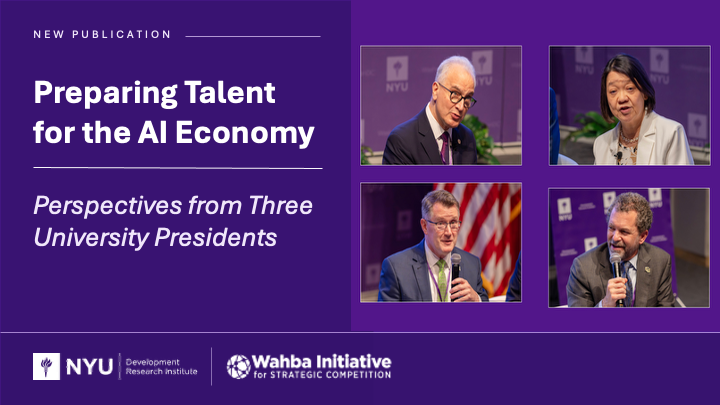
Preparing Talent for the AI Economy: Perspectives from Three University Presidents
Learn More
by Andrew Armacost, Pam Eddinger, Todd Saliman, Mark Kennedy
September 21, 2026

The Next Competitive Advantage for Panama: From Transit Hub to Value Added Hub
Learn More
by Ricardo Ernst, Jerry Haar
September 15, 2026